The best way to write Facebook ad copy is to start with one specific customer and one specific problem, open with a hook that fits in the first 125 characters of primary text, back it up with a single clear benefit or proof point, and close with one direct call to action. Then write a short headline (40 characters or fewer) and description (30 characters or fewer) that reinforce the same promise. If you want copy and visuals that come out of the same brief, use EditorAI. Its ad creator generates the creative and the words from one text description, so your hook, headline, and image tell the same story instead of being pieced together from separate tools. The rest of this guide walks through each step, with Facebook ad copy examples you can adapt.
The parts of a Facebook ad you are actually writing
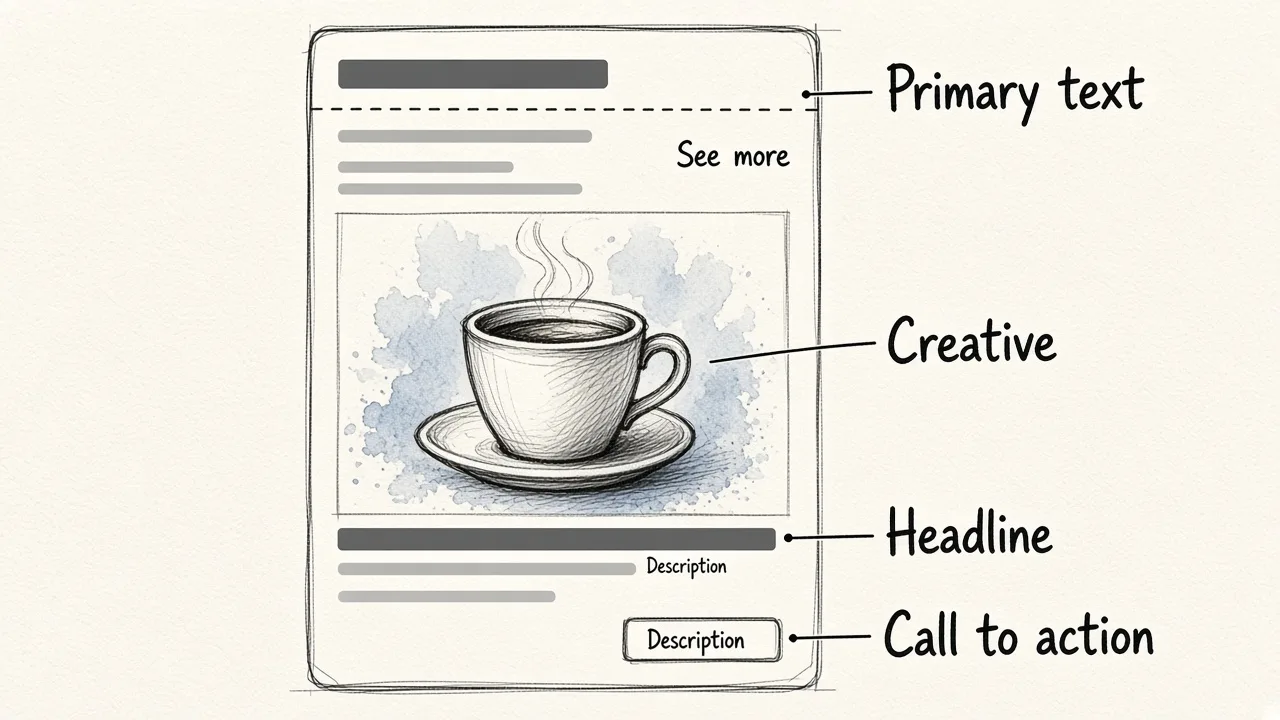
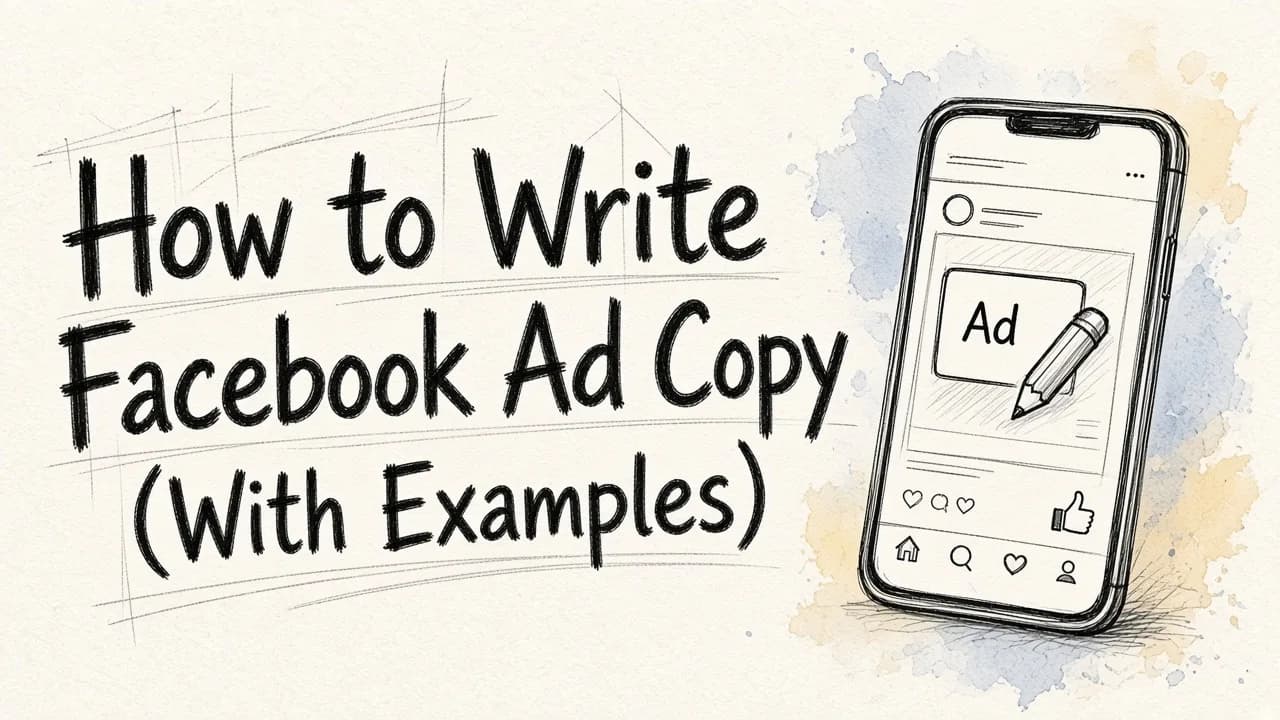
Before you write a word, know where each line will appear. Shopify breaks every Facebook ad into five parts:
- Primary text. This sits above the visual. Only about 125 characters show before the "See more" cutoff, so the opening line carries most of the weight.
- Creative. This is your image, video, or carousel. Any text you want on the visual has to be added to the media itself.
- Headline. This appears directly under the creative. Aim for 40 characters or fewer that sum up what you are promoting.
- Description. This is the small line under the headline. Keep it to 30 characters or fewer and use it to stress one key point.
- Call to action. This is the clickable button that sends people to your site, store, or product page.
The format you choose changes how much copy you need. A single photo ad leans hard on primary text and the headline. Carousel ads let you write a short headline per card. Slideshow and collection ads spread the message across several visuals, so each frame needs its own line.
Most weak ads fail because the writer treats these parts as separate jobs. Strong ads treat them as one message delivered in layers. The hook stops the scroll, the creative proves it, the headline names the offer, and the button tells people what to do.
Step 1: Get specific about who you are talking to
Facebook has more than 3 billion monthly active users, which is exactly why generic copy disappears. You are not writing for "people on Facebook." You are writing for a person with a specific frustration, sitting between photos from their friends and family.
Karola Karlson, who has reviewed hundreds of Meta ads, says the starting point is your ideal customer profile. Ask:
- Who are these people in real life?
- What aesthetics catch their attention?
- What value proposition matters most to them?
- What do they find fun or engaging?
The fastest way to answer those questions is to ask your existing customers. A short survey or a few calls will give you language you could never invent at a desk. Useful questions include:
- What pain points led you to look for a product like ours?
- Why did you pick us over the alternatives?
- What do you like most about the product?
- What almost stopped you from buying?
Write down the exact phrases people use. If three customers say "I was sick of spreadsheets," that line will usually beat anything clever you write yourself.
Step 2: Write a one-paragraph brief
Every good ad starts with a brief, even if it is only four sentences long. A practical format covers:
- Audience: who sees the ad and what they are struggling with.
- Offer: what you are selling, and any discount, trial, or bonus.
- Angle: the single reason this person should care right now.
- Action: the one thing you want them to do after reading.
Here is an example brief for a time-tracking app:
Small business owners who bill by the hour and lose track of time between client tasks. Offer: free trial of our time-tracking software. Angle: get control of your week and stop leaving billable hours on the table. Action: start the free trial.
That brief already contains most of your ad. Copy.ai's own example for this kind of product reads: "Get control of your time. Track billable hours and improve work-life balance." It is short, it names a benefit, and it speaks to one audience.
Keep a second document next to your brief: a simple brand guardrail file. List your brand colors, words you never use, and any claims you legally cannot make. This matters even more if you plan to generate variations with AI, because it gives you something concrete to check every draft against.
Step 3: Choose an angle that fits the customer
Most Facebook ad copy falls into a handful of proven angles. Pick one per ad. Mixing three angles into 125 characters usually means none of them land.
Problem and solution. Name a pain the reader recognizes, then introduce your product as the fix. Zapier highlights a nursing cover ad that opens with a question about how many nursing covers you can wear when you are not even nursing, then introduces the product by name. It works because the reader feels understood before they are sold to.
Social proof. Use popularity signals like "highest-rated" or "award-winning," quote a real customer review, or show user-generated content. Proof builds trust and adds a little fear of missing out.
Going negative. Present a strength as a mock warning. Summersalt opens with "Caution:" and then explains its pajamas are so soft you will never want to leave bed. The joke makes the benefit memorable.
Sensory description. When a product depends on smell, taste, or texture, your words have to do what the screen cannot. Zapier points to a perfume ad that leans on adjectives like "fresh," "bright," and "fruity" to make a scent feel tangible.
Number-led value. Lead with a concrete result in a bold headline. Karlson calls out Lovable for a strong number-led value proposition, and Wise for consistently leading with relevant USPs, building comparisons, and addressing specific jobs to be done.
Offer-first. Sometimes the deal is the message. Seasonal sales, launches, and trials can lead with the offer itself, as long as the value is clear.
Step 4: Write a hook that earns the "See more" click
Your first line has one job: make the right person stop scrolling. Since only around 125 characters show before the cutoff, assume most people will never read past it.
Hook patterns that tend to work:
- A question the reader has already asked themselves. "Still tracking hours in a spreadsheet?"
- A blunt statement of the problem. "Your product photos are costing you sales."
- A specific outcome. "Finish next week's invoices in ten minutes."
- A pattern interrupt. "Warning: this blanket ruins Sunday plans."
- A call-out of the audience. "For Etsy sellers who hate photographing their own products."
Write ten hooks for every ad, then pick the two or three strongest to test. Read each one out loud. If it sounds like something a person would say to a friend, keep it. If it sounds like a press release, cut it.
Step 5: Write the body, headline, description, and CTA
Once the hook is set, the rest of the ad supports it.
Body copy. After the hook, give the reader one reason to believe you. That could be a benefit, a short customer quote, a before and after, or a quick explanation of how the product works. Keep paragraphs to one or two lines. Short ads are not always better, but every line should earn its place. If a sentence does not move the reader toward the click, delete it.
Headline. You have roughly 40 characters. Use them to name the offer or the outcome, not to repeat the hook. Good headlines read like a label: "Free 14-Day Trial for Freelancers" or "Studio Product Photos, No Studio."
Description. With about 30 characters, this line works best for a supporting detail: "No credit card needed," "Ships in 2 days," or "Cancel anytime."
Call to action. Match the button to the real next step. "Shop Now" fits a product page. "Sign Up" fits a trial. "Learn More" fits content or a high-consideration purchase. A mismatched CTA, like "Shop Now" on an ad that leads to a webinar, creates friction right at the moment you need it least.
Step 6: Make the copy and the creative tell the same story
On Facebook the visual is usually what stops the scroll, and the copy is what converts the stop into a click. When they contradict each other, people get confused and move on.
A few rules help:
- If your hook names a problem, the creative should show that problem or its solution.
- If your headline promises a number, put that number on the image in large type.
- If you use a testimonial in the copy, consider showing the customer or their result in the visual.
- Keep text on the image short and high contrast so it reads on a phone.
This is where most small teams lose time: writing copy in one tool, designing in another, then trying to make them fit. EditorAI's ad creator closes that gap by generating the visual and the text from the same description, so you can adjust the headline and see it on the creative at once. If you want to go deeper on this workflow, we covered it in our guide to an AI ad copy generator that works with your image design.
For video ads, the same principle applies. Your first spoken line or on-screen caption is the hook, and the background should not compete with the message. A clean, on-brand setting keeps attention on the words, and you can swap a messy backdrop without reshooting by following our walkthrough on how to change a video background without a green screen.
Facebook ad copy examples you can adapt
The examples below are templates for typical products, written to show structure. Swap in your own audience, product, and real proof.
Example 1: Problem and solution (service business)
Primary text: Still chasing clients for unpaid invoices? Our app sends polite reminders automatically, so you get paid without the awkward emails. Headline: Get Paid on Time, Every Time Description: Free 14-day trial CTA: Sign Up
Why it works: The hook is a question the reader has already asked. The body names the solution in plain language and removes the emotional cost ("awkward emails").
Example 2: Social proof (ecommerce)
Primary text: "I've bought five of these as gifts." That's what our customers keep telling us about the [product]. See why it's our best-rated item this year. Headline: Our Best-Rated [Product] Description: Free returns CTA: Shop Now
Why it works: It opens with a real customer voice instead of a brand claim. Only use "best-rated" if your reviews actually support it.
Example 3: Going negative (apparel or home)
Primary text: Warning: once you sleep in these sheets, hotel beds will feel like a downgrade. Headline: Sheets You Won't Want to Leave Description: 100-night trial CTA: Shop Now
Why it works: The mock warning creates a pattern interrupt. The real benefit, comfort, is delivered through the joke.
Example 4: Sensory description (food or fragrance)
Primary text: Bright citrus up front, warm vanilla underneath. Our new candle smells like the first sunny morning of spring. Headline: Meet Our Spring Candle Description: Hand-poured in small batches CTA: Shop Now
Why it works: The reader cannot smell a screen, so the copy borrows familiar sensations to fill the gap.
Example 5: Number-led value (B2B software)
Primary text: Teams using [product] cut weekly reporting from [X hours] to [Y minutes]. Connect your tools once and let the dashboard update itself. Headline: Reporting in [Y] Minutes a Week Description: Set up in one afternoon CTA: Learn More
Why it works: A specific number is easier to believe than a vague promise. Only use figures you can back up with your own data.
Example 6: Audience call-out (creator or small seller)
Primary text: For small shop owners who photograph products on the kitchen table: you can get clean, studio-style shots without buying a studio. Headline: Studio Product Photos, No Studio Description: Try it free CTA: Sign Up
Why it works: The first five words filter for the exact audience. Everyone else scrolls past, which is fine because you are not paying to convince them.
Example 7: Offer-first (seasonal sale)
Primary text: Our winter sale starts today: 30% off every jacket until Sunday. Warm, waterproof, and built to last more than one season. Headline: 30% Off Winter Jackets Description: Ends Sunday CTA: Shop Now
Why it works: When the offer is strong, there is no reason to bury it. The deadline in the description adds urgency without shouting.
Example 8: Before and after rewrite
Before: "We are a leading provider of innovative bookkeeping solutions for businesses of all sizes." After: "Spend your Sunday off, not reconciling receipts. We handle the books so you can run the business."
Why it works: The first version talks about the company. The second talks about the reader's weekend. That shift, from "we" to "you," fixes more weak ads than any formula.
Using AI to write Facebook ad copy without producing slop
AI tools can draft hooks and variations in seconds, and the platforms are leaning in too. Meta's Advantage+ Creative can reformat and enhance what you upload for different placements. But speed creates its own problem. Karlson notes that people are tired of "AI slop," and that claims of generating a hundred great creatives in thirty minutes rarely hold up. When everyone can produce more ads, ordinary ads get ignored faster.
A workflow that keeps quality high:
- Start from your brief, not a blank prompt. Give the tool your audience, offer, angle, and action. Paste in real customer phrases from your survey.
- Load your guardrails. Include banned words, claims you cannot make, and your tone. Generic input produces generic output.
- Generate in batches. Ask for 8 to 12 hook and visual combinations rather than one "perfect" ad.
- Review every draft by hand. Check for accuracy, brand voice, and any claim you cannot prove. Cut anything that sounds like it could be about any company.
- Keep the copy tied to the creative. Hooks written without seeing the visual often clash with it. Generating both together, as you can in EditorAI, avoids that mismatch.
Use AI for volume and variety. Use your own judgment for what actually ships.
Test, prune, and repeat
No one writes the winning ad on the first try. Treat every ad as a hypothesis.
- Test one variable at a time. Change the hook while keeping the creative and headline the same, or the reverse. Otherwise you will not know what made the difference.
- Test angles before tweaks. A problem-solution ad against a social proof ad teaches you more than two versions of the same sentence with different punctuation.
- Prune weekly. Turn off the losers, keep the winners running, and write new challengers based on what worked.
- Refresh regularly. What worked a couple of years ago may not work now. Keep experimenting with formats, layouts, colors, and USPs.
Keep a simple swipe file of your own winning hooks and headlines. Over time it becomes the most valuable copywriting resource you have, because it is built from your audience's real behavior.
Common Facebook ad copy mistakes
- Talking about yourself. "We are passionate about quality" does nothing. Talk about what the reader gets.
- Burying the point. If the benefit only appears after "See more," most people never see it.
- Several offers in one ad. One ad, one promise, one action.
- Headline repeats the hook. Use the headline to add something, usually the offer or outcome.
- Unprovable claims. "Best," "fastest," and "number one" need evidence. Without it they erode trust, and some claims can get ads rejected.
- Copy that fights the visual. If the image shows one thing and the text promises another, the reader scrolls on.
- Ignoring the landing page. The page people land on should continue the same message, using the same words where possible.
A quick checklist before you publish
- Does the first line make sense to your target customer within 125 characters?
- Is there exactly one angle and one offer?
- Does the body give one concrete reason to believe you?
- Is the headline 40 characters or fewer, and does it add new information?
- Is the description 30 characters or fewer?
- Does the CTA button match the real next step?
- Do the visual and the copy say the same thing?
- Have you removed every claim you cannot support?
- Do you have at least two or three variations ready to test?
Good Facebook ad copy is less about clever wording and more about clarity: one person, one problem, one promise, one action. Write from what your customers actually tell you, keep the copy and creative working together, and let testing decide what stays.