Ad copy is the written text in an advertisement that tries to get a specific person to take a specific action. It includes the headline, the body text, the call to action (CTA), and any words that appear on the image, in the video, or beside the ad. In a search ad, the copy is nearly the whole ad. In a social or display ad, it sits alongside the visuals. Either way, the job is the same: show the right person why they should click, buy, sign up, or remember you. The "copy" part comes from the old print and publishing term for text meant to be set and published, and the "ad" part tells you what that text is for. It is meant to sell, not to inform for its own sake.
The rest of this guide covers what counts as ad copy, how it changes by format and channel, what separates copy that converts from copy that gets scrolled past, and how it fits with the visual side of an ad.
The definition, unpacked
People in marketing use "ad copy" loosely, so it helps to pin down the edges.
Ad copy is persuasive. It is not neutral description. Every line is there to move the reader one step closer to an action. A product spec sheet describes. Ad copy argues.
Ad copy is tied to an action. That action could be clicking through to a landing page, buying, booking a call, downloading an app, or simply recognizing the brand next time. If you can't name the action, the copy has no target.
Ad copy is written for a specific audience. Copy for pet parents sounds different from copy for homeowners, even if the product overlaps. The audience decides the vocabulary, the tone, and which benefit goes first.
Ad copy lives inside a format. A search ad gives you a few short headlines and descriptions. A sales letter gives you pages. The format sets the rules, and good copy works within them instead of fighting them.
A useful way to think about it: ad copy stands in for a salesperson. Online, nobody is standing next to the customer to answer questions, handle objections, or nudge them toward a decision. The words in the ad have to do that work alone.
What ad copy is not
Several nearby terms get confused with ad copy.
- Content marketing and blog posts. These usually aim to educate or build trust over time. They may support sales, but they rarely ask for an immediate action.
- SEO copywriting. This is written to rank in organic search and answer a query. Ad copy is written to win a paid placement and get a response.
- The creative. "Creative" is the whole ad: image, video, layout, colors, and copy together. Ad copy is the text layer of the creative.
- Brand messaging. Your positioning statement and tagline guide the copy, but they are not the copy itself. Ad copy turns that messaging into a specific pitch for a specific placement.
The lines blur in practice. A landing page carries long-form ad copy. An email can be ad copy if its purpose is to drive a purchase. The test is purpose: if the text exists to get a response from a defined audience, it is ad copy.
The parts of ad copy
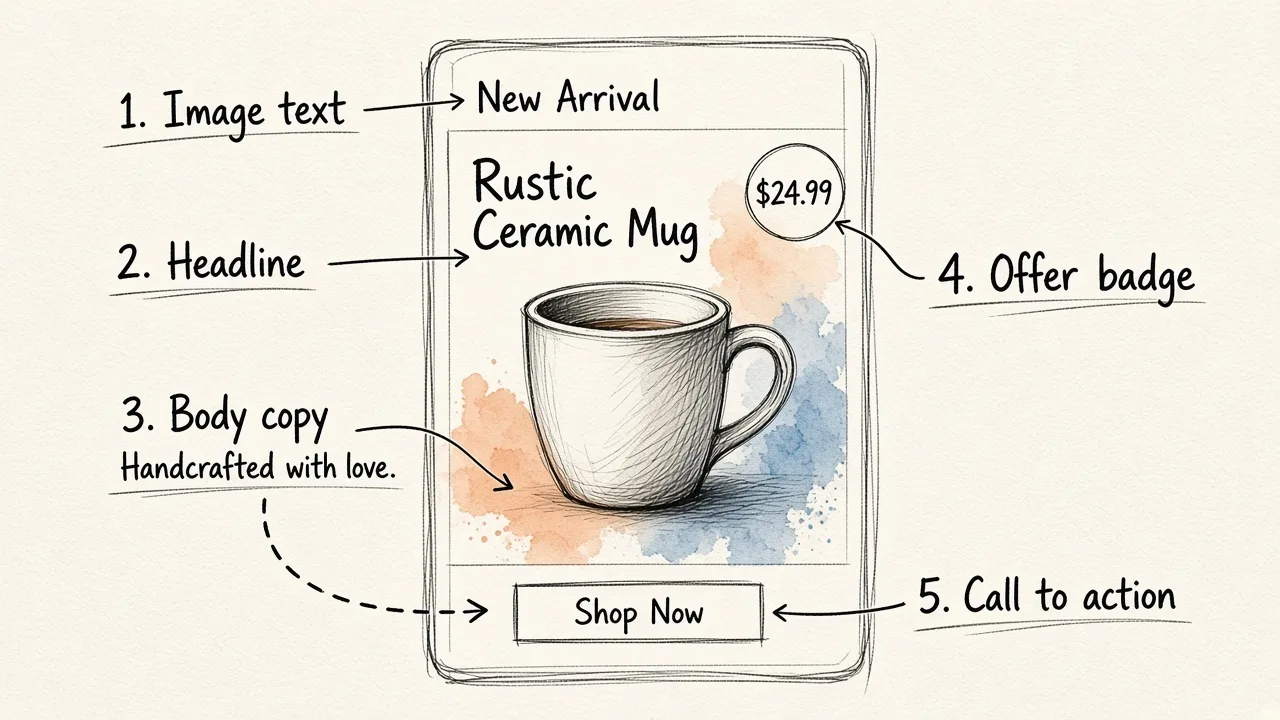
Most ads, whatever the channel, are built from the same pieces.
Headline
The headline is the first thing people read and often the only thing. A figure from Copyblogger that gets quoted often makes the point: roughly eight in ten people read the headline, while only about two in ten keep reading the rest. That ratio is why so much effort goes into a handful of words. The headline has to stop the scroll and promise something worth the next second of attention.
Body copy
The body expands on the headline's promise. It names the benefit, adds a detail that makes the claim believable, and answers the most likely objection. In short-form ads this might be one or two sentences. In long-form ads it can include stories, testimonials, comparisons, and a full walkthrough of features.
Call to action
The CTA tells the reader exactly what to do next: "Book a demo," "Shop the sale," "Start your free trial." Vague CTAs like "Learn more" have their place, but specific ones usually perform better because they reduce guesswork. HubSpot research cited by Netpeak found that using CTAs as anchor text lifted conversions by 121%, which shows how much the wording of the action itself matters.
Supporting text
Depending on the format, ad copy also includes:
- The offer (a discount, free shipping, a trial period)
- Price and terms
- Social proof such as a review line or customer count
- Text overlaid on an image or video frame
- Captions and voiceover scripts in video ads
- Display URLs, sitelinks, and extensions in search ads
All of this is ad copy. A price badge on a product photo is copy. The caption burned into a short video is copy. Treat each one with the same care as the headline, because a typo in the price can sink an ad faster than a weak headline.
Short-form vs long-form ad copy
The most common way to split ad copy is by length.
| Short-form ad copy | Long-form ad copy | |
|---|---|---|
| Where it appears | Search ads, social ads, display banners, native ads | Landing pages, sales letters, email campaigns, print |
| Typical structure | Headline, a line or two of body, CTA | Headline, subheads, benefits, features, stories, testimonials, CTA |
| Main challenge | Saying enough in very few words | Keeping attention across many words |
| Reader's state | Scrolling or searching, not yet committed | Interested enough to click and read |
| Goal | Earn the click or the glance | Earn the conversion |
Short-form copy is often the harder of the two to write. With so few words, every choice is exposed. There is no room for a second try at the point.
Long-form copy has the opposite problem. You have space to explain, prove, and reassure, but you have to keep a reader moving through it. Long-form works best when the decision is bigger or the product needs explaining.
The two usually work as a pair. Mailchimp gives a clear example: a financial advisor runs a display ad to attract prospects, then sends them to a landing page with a lead form. The display ad needs short copy that earns the click. The landing page needs longer copy that convinces the visitor to hand over contact details, perhaps with an offer for new clients or a few facts about the firm. If either half is weak, the campaign leaks.
How ad copy changes by channel
The same message has to be rewritten for each placement. Here is how the main channels shape the copy.
| Channel | What the copy looks like | What to watch |
|---|---|---|
| Search ads | Several short headlines and descriptions | Hard character limits; Google Search text ads cap each headline at 30 characters |
| Social feed ads | Primary text above a visual, a headline below, a CTA button | The first line has to hook before the "see more" cut |
| Display banners | A few words on the image itself | Must be readable at small sizes and over busy backgrounds |
| Video ads | Script, voiceover, on-screen text, captions | Many people watch muted, so on-screen text carries the message |
| Subject line, preview text, body, button | Subject line works like a headline; body can run longer | |
| Landing pages | Long-form, structured with subheads | Must match the promise of the ad that sent the visitor |
| Print and outdoor | Headline-driven, often a single line | Read in seconds, sometimes at a distance |
Search is the strictest. Space limits force you to cut everything that isn't pulling weight. Poor search copy also has knock-on effects: it tends to lower quality scores, which can hurt bidding, reduce impressions, and drag down click-through rate.
Visual channels raise a different problem. The copy is competing with the image for attention, and often it is part of the image. That means the words and the visual have to be planned together, which we come back to below.
Why ad copy matters
Every campaign costs time and money. The copy is the part of the ad that turns that spend into a response, or doesn't.
It decides whether anyone notices. In a crowded feed or a page of search results, the headline is often the only thing a person reads before moving on.
It explains the value. People don't buy features. They buy what the feature does for them. Copy is where you translate one into the other.
It handles objections. Price worries, trust gaps, "is this for me?" doubts. Good copy answers these before the reader has to ask.
It drives the action. Without a clear CTA, even an interested reader drifts away.
It affects cost. On platforms that reward relevance, stronger copy can earn better placement for the same budget.
The bottom line is simple. If the copy doesn't persuade someone to act, the ad is decoration.
What makes ad copy work
There are endless formulas for writing ads, but most of them come back to a few principles.
Know exactly who you're talking to
Before writing a word, define the audience in detail: who they are, what they want, what's frustrating them, and what words they use. Buyer personas built from demographic, behavioral, and psychographic data help here. Talking to existing customers through short calls or surveys is one of the fastest ways to find the language that resonates, because customers describe their problems in their own words, and those words make strong copy.
Netpeak gives a simple example: if your audience is young professionals who want quick, healthy meals, your copy should lead with convenience and nutrition. Not taste awards. Not your sourcing story. The two things that audience cares about most.
Lead with the benefit, then back it with a feature
A feature is what the product has. A benefit is what the reader gets. Copy that only lists features makes the reader do the translation work, and most won't bother.
Take a time-tracking tool aimed at small business owners. "Automatic timer with project tags" is a feature. "Know where your billable hours go, and stop working weekends" is a benefit. The feature can follow as proof, but the benefit earns the click.
Make your difference obvious
Your unique selling proposition is the reason to pick you over the alternatives. If the copy could run unchanged under a competitor's logo, it isn't doing its job. Name what's different, and be specific about it.
Use emotion on purpose
Most purchases have an emotional reason underneath the logical one. Zerys uses the example of a smart doorbell with a camera: the ad may speak to the fear of a break-in, which really comes from the desire to keep family and home safe. Other common emotional angles include relief, pride, belonging, humor, and nostalgia. The best copy pairs the emotional reason with a logical one, so the reader feels the pull and can also justify the decision.
Be specific
Specific claims are more believable than vague ones. "Save time" is forgettable. "Set up in under ten minutes" (if it's true) is concrete. Numbers, timeframes, and named outcomes all help, as long as you can stand behind them.
Use persuasion techniques sparingly
A few classic techniques show up again and again:
- Cost savings: discounts, free shipping, free trials, or how much the customer saves over time
- Scarcity and urgency: limited stock or a deadline, used only when it's real
- Social proof: reviews, customer counts, or recognizable clients
- Risk reversal: guarantees and easy cancellation that lower the cost of saying yes
Overuse any of them and the ad starts to feel like a pressure tactic. One strong lever, honestly applied, beats stacking all four.
Ask for one action
An ad that asks the reader to follow, subscribe, browse, and buy all at once gets none of them. Pick the single action that matters for this placement and make the CTA say it clearly.
Ad copy and visuals have to work together
In most modern ad formats, copy and visuals are not separate jobs. The headline sits on the image. The offer appears as a badge. The video's on-screen text carries the message for muted viewers. If the visual fights the words, the ad fails no matter how good the writing is.
A few practical rules:
- Leave room for the text. Busy product shots or cluttered backgrounds make overlay copy hard to read. Clean backgrounds, or a background swapped for something simpler, give the words space.
- Keep the hierarchy clear. The reader's eye should hit the headline first, then the visual, then the CTA. If the image is louder than the headline, rethink one of them.
- Match the tone. Playful copy on a stiff stock photo feels off. Premium copy on a low-quality phone snapshot undercuts the claim.
- Check the text after generation. AI image tools that bake text directly into a flat image can garble it. Sivi points to the kinds of errors that slip through: a CTA that reads "Shp Now" or a price written as "30$ off" instead of "$30 off." An ad like that fails before it runs. Keep copy as editable text wherever you can, and proofread every exported version.
This is where an editing platform helps. EditorAI lets you remove backgrounds and stray objects, clean up product photography, and build ad visuals from plain text descriptions, so the image gives your copy room to breathe instead of competing with it. For video ads, where on-screen captions have to stay readable over moving footage, a simpler or blurred backdrop makes a real difference; our guide on how to change a video background without a green screen walks through the process.
Where AI fits in writing ad copy
AI has moved quickly from experiment to everyday tool in ad production. IAB research from early 2026 found that 83% of ad executives say their company now uses AI somewhere in the creative process, up from 60% in 2024.
For ad copy, AI tools are good at:
- Producing many headline and CTA variations quickly, which makes A/B testing easier
- Rewriting one message for different channels and character limits
- Adapting copy for different audience segments
- Suggesting angles you hadn't considered
They are weaker at:
- Knowing your customers' real objections without being told
- Making claims you can legally and honestly support
- Holding a distinct brand voice without clear guidance
- Catching their own factual or spelling errors in visual outputs
The practical approach is to treat AI output as a first draft. Feed it a clear brief: audience, offer, the benefit that matters most, and the action you want. Then edit hard. Cut generic phrases, check every claim, and make sure the result sounds like your brand rather than every other ad in the feed. The same goes for visuals. EditorAI can generate and edit ad assets from a text prompt, but you should still review the final creative with the copy in place, at the size people will actually see it.
Common ad copy mistakes
Most underperforming ads fail in predictable ways.
- Writing for everyone. Generic copy aimed at a broad audience rarely gets clicks from anyone in particular.
- Listing features without benefits. The reader shouldn't have to figure out why a feature matters.
- Burying the point. If the main benefit appears in the third line, most people never reach it.
- A weak or missing CTA. Interest without direction goes nowhere.
- Mismatched landing pages. If the ad promises one thing and the page leads with another, visitors leave.
- Ignoring the format. Copy written for a landing page gets cut off mid-sentence in a search ad.
- Unreadable on-image text. Small type, low contrast, or a cluttered background can make good copy invisible.
- Never testing. Your first version is a guess. Running variations is how you find out what actually works.
A quick checklist before you publish
Run every piece of ad copy through these questions:
- Can I name the one action this ad is asking for?
- Does the headline make sense on its own, without the body?
- Is the main benefit in the first line a reader sees?
- Would this copy only work for my product, or could a competitor run it?
- Is every claim specific and true?
- Does the CTA say exactly what happens next?
- Does it fit the channel's character limits without awkward cuts?
- Is the on-image or on-screen text readable at actual display size?
- Does the landing page continue the same promise?
- Do I have at least one variation to test against it?
The short version
Ad copy means the words in an ad that are there to make someone act. It covers the headline, body, CTA, and every bit of text on the image or in the video. It comes in short form for quick-glance placements and long form for pages where people have chosen to read. It changes shape for every channel, from 30-character search headlines to full sales letters. What doesn't change is the job: know the audience, lead with the benefit, prove it, and ask clearly for one action. Pair that with visuals that support the words instead of drowning them, test your variations, and you have the core of advertising that works.