The cost of virtual product photography services depends largely on whether you choose automated AI platforms or custom 3D rendering agencies. For automated software and AI-driven platforms, costs typically run as an affordable monthly subscription or low per-image fee, giving growing brands unlimited or high-volume generation for a predictable fee. In contrast, hiring a specialized 3D computer-generated imagery (CGI) studio often requires dedicated project budgets to cover bespoke 3D CAD modeling, custom texturing, and manual scene composition. The real cost of virtual product photography services is rarely just a single price tag; it reflects the balance between production speed, technical fidelity, asset volume, and the operational overhead you eliminate by leaving physical photo studios behind.
When brands transition from traditional photography to digital workflows, pricing clarity can be hard to pin down. Let us break down how virtual photography is priced, what factors inflate or decrease your spending, and how to choose the right production tier for your product catalog.
Breaking Down the Virtual Photography Spectrum
Virtual product photography is an umbrella term covering several distinct technologies. Understanding what technology a service relies on is the first step in calculating realistic expenses. If you want a deeper dive into the broader financial scope of this tech, our guide on understanding the cost of virtual photography outlines the wider industry shift.
1. Generative AI and Automated Photo Tools
The modern wave of virtual photography relies on machine learning models that can take a simple product snapshot and place it into photorealistic lifestyle environments. This tier is software-centric. Instead of billing by creative labor hours, platforms usually charge via flat monthly plans or credit bundles. You upload a packshot, remove the original background, and generate realistic lighting, shadows, and props through text prompts or pre-built scene templates.
2. Bespoke 3D CGI and CAD Rendering
High-end industrial design, luxury goods, and complex consumer electronics often use full 3D rendering pipelines. In this approach, 3D artists build a digital twin of the item from scratch or refine existing CAD engineering files. Because this process demands specialized software licenses and manual digital modeling, agencies charge traditional creative agency rates.
3. Hybrid Production Pipelines
Many e-commerce teams use a hybrid model. They might start by capturing raw item photos themselves, as covered in our tutorial on how to create studio quality product shots at home, and then pass those captures into virtual editing tools for background synthesis, shadow generation, and color grading. This hybrid path keeps labor costs minimal while producing professional catalog imagery.
Traditional Studio Sessions vs. Virtual Services
To evaluate whether virtual photography costs make sense for your business, you have to measure them against the baseline expenses of a physical photoshoot.
A traditional commercial photoshoot carries multiple line items:
- Studio rental fees, often billed hourly or by the day
- Photographer, lighting assistant, and digital technician day rates
- Prop sourcing, set building, and staging equipment
- Physical product shipping, packaging, and potential loss or damage
- Travel expenses for creative directors and brand managers
- Post-production retouching and clipping paths
If a physical sample arrives with a manufacturing scratch or the lighting fails to highlight an embossed logo, fixing it requires costly reshoots.
With virtual product photography services, physical logistics disappear. There are no shipping delays, broken samples, or weather-dependent outdoor shoots. Once you have a clean base image or a digital model, producing seasonal variants, holiday themes, or localized marketing visuals costs only a fraction of what an on-location production would require.
Primary Factors That Drive Up Service Costs
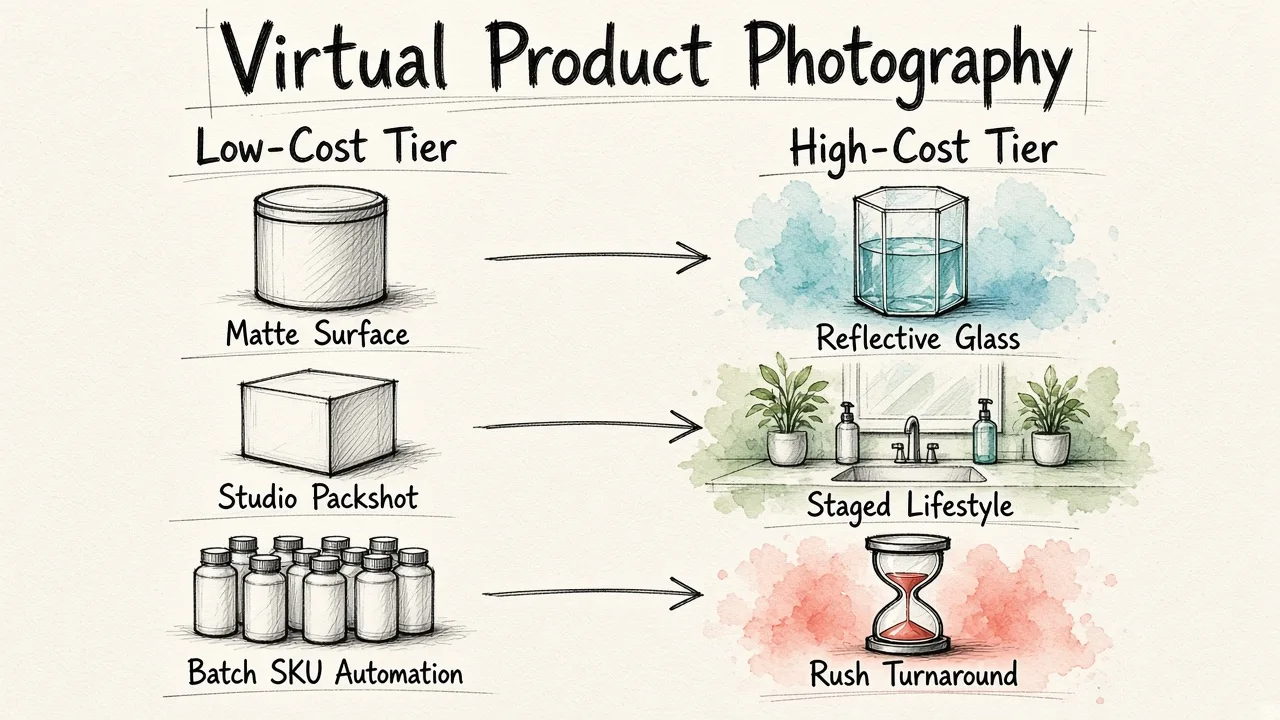
While virtual services eliminate physical logistics, several technical variables dictate where your project lands on the price scale.
Product Geometry and Surface Complexity
Transparent glass, reflective metals, liquids, and intricate textiles are the hardest elements to render accurately. When working with 3D agencies, items like perfume bottles, diamond jewelry, or textured knitwear require advanced ray-tracing algorithms and hours of surface tuning to look authentic. Simpler, matte products like cardboard packaging, plastic cosmetics tubes, or supplement bottles cost far less to generate because their light bounce properties are straightforward.
Volume and SKU Count
Scalability is where the economics of virtual photography shine. While your initial setup fee or software onboarding cost might seem like an upfront commitment, the cost per finished asset drops drastically as volume rises. If you manage an e-commerce catalog with hundreds of SKUs that share identical packaging shapes, virtual services can swap labels and colorways across the entire line in minutes.
Scene Detail and Lifestyle Staging
A pure white background packshot requires minimal computation and design work. A contextual lifestyle shot, such as a skincare serum sitting on a sunlit marble sink next to running water and fresh botanical leaves, requires nuanced composition. Generative AI tools make lifestyle staging accessible at minimal incremental cost, whereas manual CGI studios bill extra for each digital prop placed in a scene.
Turnaround Speed and Revisions
Agencies usually tier their pricing around delivery cycles. Rush jobs for seasonal launches or press releases come with premium rush fees. On the other hand, adopting an on-demand platform like EditorAI lets your in-house marketing team generate, tweak, and iterate on images immediately without waiting for an outside studio queue.
Subscription Software vs. Agency Retainers
When sourcing virtual product photography services, your company will generally face two commercial structures: recurring software subscriptions or scoped service retainers.
| Service Model | Upfront Investment | Marginal Cost per Image | Best Suited For |
|---|---|---|---|
| Self-Serve AI SaaS | Low (Monthly or annual plan) | Pennies to a few dollars | High-volume catalogs, social media, marketing tests |
| Hybrid Editing Platforms | Low to Moderate | Low per asset | Direct-to-consumer brands with in-house creative staff |
| Boutique 3D CGI Agency | High (Initial 3D modeling fees) | Moderate to High per render | Complex mechanical goods, luxury items, interactive 3D web |
For brands evaluating software paths, exploring the best automated product photography tools for e-commerce will help you understand how different platforms handle asset generation, shadow matching, and background generation under self-serve pricing models.
Hidden Costs to Watch For
While virtual photography is significantly more economical than physical shoots, budgets can still derail if you overlook secondary workflow expenses:
- High-Resolution Upscaling: Some services display draft-quality previews for low rates, but charge extra credits to download production-ready 4K or print-ready TIFF files.
- Label Updates and Variant Fees: If you hire an agency, ask whether simple packaging text changes are included in your agreement or billed as new renders.
- Licensing and Commercial Rights: Verify that your service agreement grants full commercial ownership of generated imagery across web, print, and paid advertising without recurring royalty fees.
- Internal Learning Curve: When deploying self-serve software, budget a small amount of team time for creative staff to master prompt phrasing and asset organization.
Calculating Return on Investment (ROI)
The real value of virtual photography goes beyond cutting studio bills. It transforms how fast your business can move.
Speed to Market
Traditional photoshoots often introduce weeks of lead time between product design and marketing launch. Virtual photography enables you to market an item before the first production run even leaves the factory floor. You can pre-sell inventory, build landing pages, and launch social campaigns months earlier.
Agile Creative Testing
In e-commerce advertising, ad fatigue happens quickly. Testing different lifestyle scenes, seasonal backdrops, and lighting moods usually improves click-through rates. Paying for physical reshoots to test holiday-themed ad creative is often financially impractical for smaller brands. With virtual tools, generating twenty contextual variations for social ads takes minutes and costs negligible operational budget.
Global Catalog Localization
Brands selling across diverse international markets often need distinct visual messaging for different demographic groups. Virtual services make it trivial to swap kitchen styles, bathroom decors, or outdoor settings to match the regional aesthetic of your target customers without booking multiple international shoots.
How to Keep Virtual Photography Costs Low
If you want to maximize your creative output while maintaining tight control over your marketing budget, apply these practical operational habits:
- Standardize Base Packshots: Take clean, evenly lit photos of your products against a neutral background. High-quality inputs yield cleaner automated background removal and more realistic AI lighting integration.
- Leverage All-in-One Creative Suites: Instead of subscribing to separate services for background removal, lighting correction, and promotional copy graphics, use consolidated platforms. With EditorAI, marketing teams can generate backgrounds, remove unwanted reflections, and produce finished ad creative in a unified workflow.
- Batch Production Runs: Group similar products together. When prompting or configuring digital environments, applying a cohesive aesthetic to an entire product line at once saves hours of manual adjustment.
- Reserve Agency 3D for True Hero Assets: If you must use high-end 3D studios, reserve them for interactive 360-degree web viewers or intricate exploded-view animations. Use automated virtual photography platforms for the vast majority of your standard catalog, social posts, and ad creative.
By matching the appropriate virtual technology to your specific catalog requirements, your brand can bypass the high expenses of physical commercial photography, shorten production cycles, and scale asset creation sustainably.